
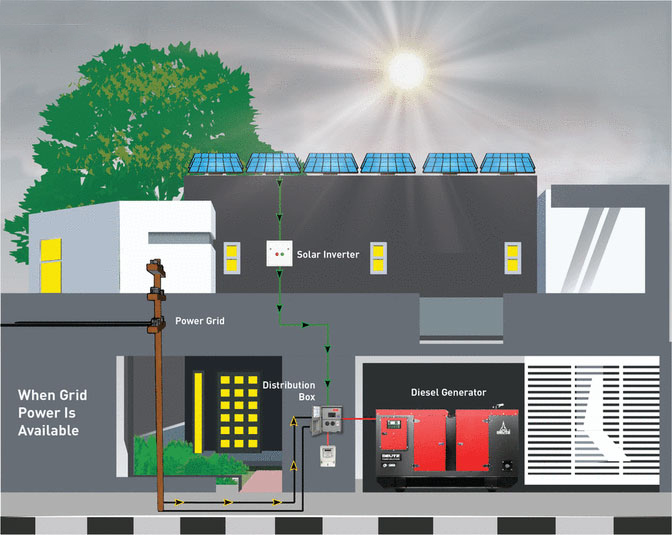
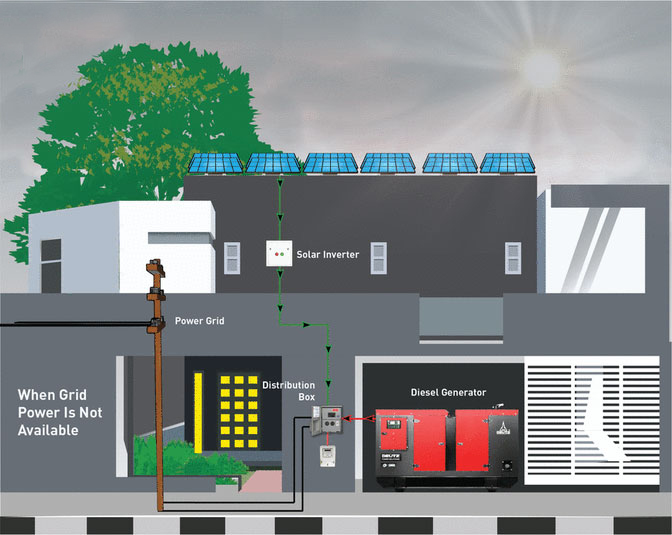
When the rays of the sun fall on solar modules placed on the rooftop of houses, commercial building or industries, the individual cells inside the module help convert sunlight into DC electricity. However, most appliances in our home work on AC electricity, and therefore the modules are connected to an inverter which does this conversion. Once the conversion has happened, the output of the inverter which is AC electricity, is connected to the mains of your home to allow you to use solar energy.
It is important to note that you can use electricity from your rooftop solar power plant in conjunction with the electricity sourced from your DISCOM. This kind of arrangement is very common and one that solar installers are expert at managing. However, if you want to go with a system that is backed by a battery to help you use solar at night time, you must go for a hybrid or an off grid system. What exactly is that? That brings us to the next section, which is what are the different kinds of solar systems that you can opt for:
Types of solar systems:
Grid connected systems or on-grid systems, are solar systems that are connected to the building mains directly. These systems give priority to the solar power generated and only if the generated power is less than that required, will the grid power be used. As explained above, inverters are used to convert the produced DC electricity to AC. In case you opt for a grid connected system, you are eligible for Net Metering, a process where all the excess power that you produced is fed back to the grid and you receive a credit for the same. In case you generate more than you consume in one complete year.
Off-grid solar systems are different from the on-grid system in the sense that they are set up independently from the state grid. These systems have an additional battery backup system which is charged by the generated solar energy. Batteries are charged when the generated power is more than the power being consumed. While on paper, battery backed systems sound like a great idea, these systems are generally more costly than on-grid systems and have lower efficiency. The battery needs to be replaced every five years or so but on the positive side, you can use solar energy even in the hours where there is no generation. Off-grid systems are perfect for your rooftop solar plants if you have a very erratic power supply or do not get any power at all.
A hybrid system brings the best of both worlds and is a combination of an on-grid and off-grid solar system. Hybrid systems have a battery backup which helps store the generated energy. What differentiates hybrid systems from off-grid systems is that, once the battery is fully charged, any excess power generated which is not being utilised will be fed back to the grid and the you will get suitably compensated. A hybrid system can also have other sources of energy producers, such as Diesel Generator (DG) or Wind coupled in the system.
Can I install rooftop solar?
The short answer to the question is that as long as you have a rooftop, there is nobody who can stop you from installing a rooftop solar system. Even if you are living in a high rise, you should check up with your RWA as societies today tend to have shared rooftops where there is a provision. However, there are some obvious things to consider before you decide to install rooftop solar on your house:
Area: First thing you must check is whether you have enough clear area to install solar panels. Also, the area should be enough to house the panels that are recommended for the system that is adequate to meet your demands.
Net Metering: Just like solar policy, Net Metering policies differ from state to state. Some Electric Companies are faster in processing the applications whereas some are slower. It would not be a bad idea to speak to your Electric Companies or solar installer regarding Net metering before you decide to go solar.
Approvals: Installing rooftop solar PV plant may require an approval or NOC from your Electric Companies depending upon the type and size of your solar system. Also, some states including Pakistan have a more relaxed approach towards approvals. It is no doubt that in states like these, installing rooftop solar is a much faster process. If you live in a society of flats, you may need approvals from your RWA, so you should check upon that too.
Shading: If your rooftop is heavily shaded by nearby objects, it may prove to be not the most ideal place for installation of solar panels. If you have a lot of shading on your rooftop, there are some alternatives that the Engineering & Design team can offer, but there is no universal solution to the same.
How can HEnterprises Energy help you to install rooftop solar?
Hassan Enterprises. is an online platform lead rooftop solar company which uses engineering, data and analytics to deliver the most suitable and customized solar solutions to residential, commercial and industrial energy consumers. It aims to transform the way solar energy is perceived, bought and sold in the country today. Right from the decision making stage, all the way up to installing your rooftop solar PV plant and for 25 years beyond, Hassan Enterprises promises to be with you and accompany you.
We help you:
- Evaluate your solarization potential using our advanced yet easy to use tools.
- Compare quotes from a list of pre-screened installers so that you are sure that you always get the most competitive and best prices in the market
- Buy your solar system once you have chosen the best quote and provide you with financial options and secure payment mode too.
Our aim is to:
- Simplify solar for you
- Provide you with competitive pricing
- Ensure you only deal with us and our pre-screened installers
- Make buying solar simple and easy
- Present Easy Financing options and help you get easy to service loans
- Ensure high standards of quality are maintained
- Give you a lifetime of support.